Showing posts with label new hope borough council. Show all posts

Friday, September 9, 2016

New Hope Will Try to Double Parking Meter Rates Oct. 18 to Help Revitalize Local Economy


By Charlie Sahner

New Hope Borough Council will vote as early as Oct. 18 on a proposal that would see parking meter rates double on Main Street in what Borough Council President Bill Scandone said in a Sept. 3 statement was an attempt to “revisit the perennial conundrum of parking.”

“There has been a significant amount of dialogue and research involved with the Revitalization Committee, and I have been involved with data gathering and analysis,” Scandone said. “There was a 2010 study, and we’re following up on that with information gathered since then.”

If it seems unusual that a group charged with boosting New Hope’s economic prospects would recommend raising parking prices for the very tourists on whom New Hope merchants depend for their livelihood, it’s because they and some other New Hope officials believe that the shortage of parking spaces in New Hope is caused by employees of businesses snatching up all the good spaces near where they work on Main Street. Scandone, Revitalization Committee Chairperson Joseph Franlin, and other New Hope officials believe that doubling the rates on Main Street parking meters could drive local workers farther away from the center of town, leaving more parking space for visitors. Paying twice as much to park at Main Street meters “would be a bargain for visitors, given the rates charged by private lots,” according to Scandone.

“Parkmobil and other devices have made parking meters more versatile,” he explained. “Presumably, therefore, it would be possible to charge different rates for different locations throughout the borough.”

In fact, the ability to raise parking rates quickly and easily was a major consideration in the adoption of the Parkmobil phone-based parking meter payment system by New Hope in the spring of 2015, according to Borough officials interviewed at the time. Parkmobil users also automatically receive warnings on their cell phones when their parking meters are about to run out. Unfortunately for the borough, revenue from parking tickets dropped as a result. Parking meter payments and parking tickets make up a significant portion of New Hope’s annual operating budget, which has been under intense pressure for some time.

On Oct. 21, 2015, the Free Press reported that the Revitalization Committee of New Hope Borough Council had already recommended raising parking rates and extending parking meter hours of operation to compensate for the shortfall. At the time, the Revitalization Committee and Borough Council were also discussing a move to require “registration” by commercial building owners to assess fire safety, property maintenance and “appearance,” and charging them a $65 annual inspection fee. That move ultimately morphed into the adoption of the Pennsylvania Uniform Construction Code by Borough Council last month.

Borough officials interviewed since 2015 have downplayed the negative impact of the Parkmobil system on revenue, saying at first that there was not enough data to support the assertion, and later saying that parking ticket revenue overall has not declined, without explaining how they are offsetting the loss from Parkmobil.

When the Revitalization Committee advised in 2015 that the borough should consider raising parking rates and extending meter operation times to compensate for a shortfall in parking ticket income, borough council initially supported a parking meter rate hike, but was reportedly lukewarm on extending hours, sources indicated. In the end, the whole proposal seems to have been tabled.
At the time, Revitalization Commitee Chairperson Joe Franlin vigorously denied that any parking recommendations or advice had been discussed with Borough Council. Franlin is one of four contenders being considered Sept. 20 for the Borough Council seat being vacated by Cliff Montgomery.

Ironically, Montgomery and fellow Borough Council Member Connie Gering appear to have been active in the Revitalization Committee’s moves since 2015, belying assertions that the parking rate increase plan being considered on Oct. 18 is of recent vintage. Franlin continues to decline comment on questions about when he advised Borough Council on parking increases, and why the Revitalization Committee appears to be more concerned with closing the borough’s budget gap than boosting business prospects.

“I would like to point out that many of the answers to your questions can be found in the 27 months of Revitalization Committee minutes and two annual summaries that have been produced during my tenure as President,” said Chairperson Franlin in a statement.

Scandone refused to say whether the current plan is an extension of the one first presented to Borough Council President Claire Shaw and others in September 2015, or a new proposal by Franlin, and whether he and other council members initially adopted Parkmobil to enhance visitor parking convenience, or expand future flexibility to increase parking rates.

Reaction on the street to the Borough’s parking scheme was generally negative.

Business owner and resident Joel Roberts.

“We don’t want any parking increase placed on the back of tourists,” said one angry retailer.

Another retailer was fatalistic, saying, “They should create a space for local employees to park. But they’ll get an increase anyway. Let them have 25 cents if they have to. Just don’t tell the tourists.”

Mystickal Tymes owner and New Hope resident Eric Lee said he “could live with” a 25-cent parking increase, but that increasing some parking ticket amounts should also be considered.

New Hope resident, former Zoning Hearing Board Member, and Mechanic Street Mugs Owner Joel Roberts said, “This is a tourist town. A majority of the budget of the town comes on the backs of the tourists — parking meters, parking tickets, the Business Privilege Tax, and sales tax. So when you do something that hurts business, you’re killing the goose that laid the golden egg.

“It’s hard to understand how they can make it easier for tourists to pay for parking, then raise the rates on them,” continued Roberts. “It takes advantage of them. That’s ridiculous.”

Two other residents interviewed Wednesday were adamantly opposed to any parking increase.
“We don’t need our taxes going up because nobody comes here anymore,” said one.

“A disaster,” remarked another.

Meanwhile, Borough Council continues preparations for a parking rate increase.

“Assuming all the data are scrubbed and verified, a presentation is scheduled for consideration at the 18 October 2016 Borough Council meeting,” wrote Scandone in a statement.

Tuesday, June 17, 2014

New Hope Borough Council president risks appearance of conflict of interest by not recusing herself from review of project next door

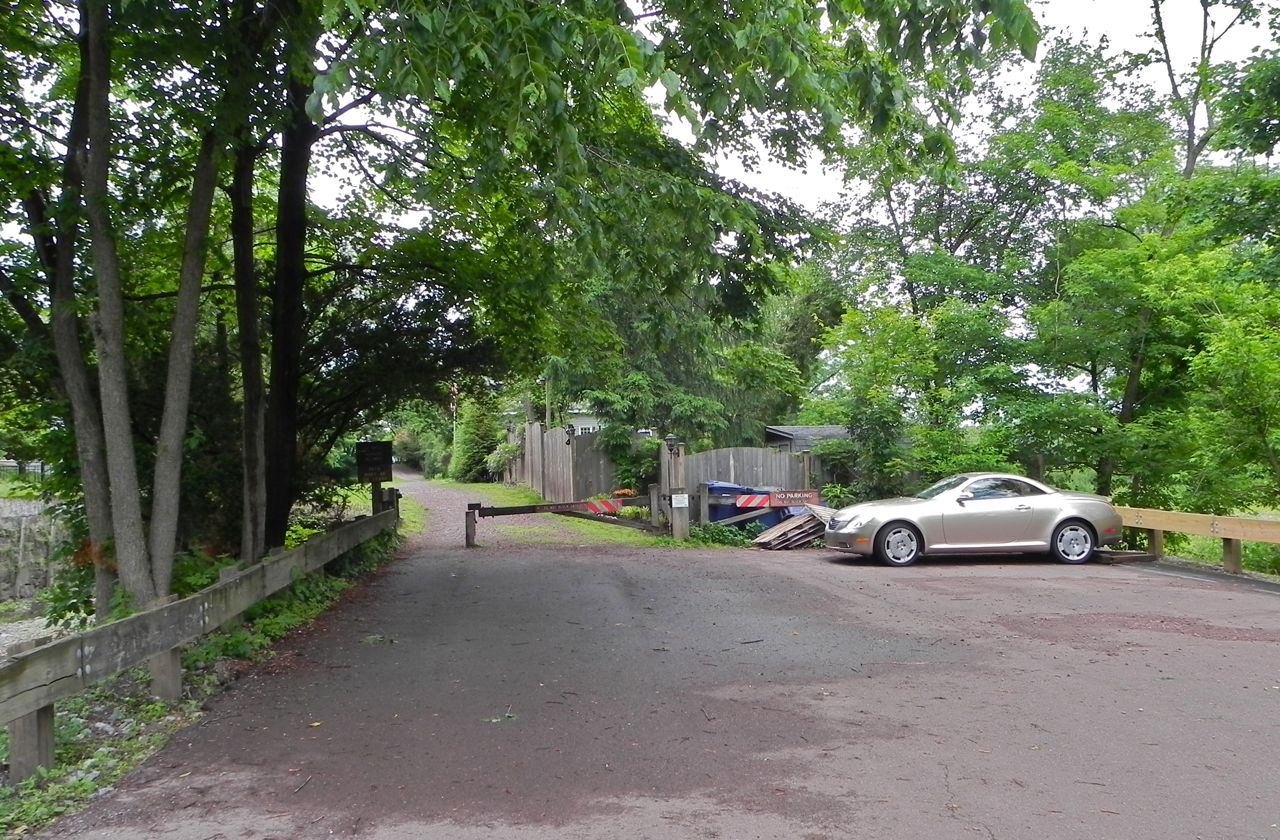
Proposed project site (foreground) and Dr. Shaw's property (background)
Proposed project site (foreground) and Claire Shaw’s property (background, fenced)

New Hope Borough Council President Claire Shaw would be well-advised to create some distance between herself and the borough’s review of the proposed four-story boutique conference center that investors want to build next to her property to avoid the appearance of a conflict of interest, say ethical experts.

Shaw disagrees: “I have no intention of recusing myself from the decisions on this project. The location of my property to the proposed site is not a conflict of interest and I find your suggestion that it may be, offensive.”

As previously reported, members of New Hope’s Historic Architectural Review Board (HARB) were shocked at their June 3 meeting by Borough Council President Claire Shaw’s pronouncement that not only had their request to retain a structural engineer to assess the feasibility of preserving the former Odette’s restaurant been overruled, but also that “Council decided to handle this from this point forward.”

Getting a structural engineer to assess the cost of preserving the remaining portions of the historic 1784 structure is vital to HARB members because it lets them assess practicality of preservation efforts and their financial burden on the project applicant.

In response to questions by HARB members, Shaw asserted at the June HARB meeting that, ”We are not really getting a study, we’re having an open house…council will then decide if we want to request a formal structural report. Based on what we see and hear, the seven of us will decide what to do next.” Council and HARB members attended a tour of Odette’s last week organized by the applicants although HARB members had asked to delay the tour until they first reviewed a valid structural engineer’s report.

Under further questioning on June 3, Shaw explained, “I think this was sort of taken out of your hands because they [the applicants] were not treated very fairly at the first go around with this board.”
HARB member Dee Dee Bowman responded, “We simply stated that we did not think their report was adequate.”

“Because of what transpired, right or wrong, Council decided to handle this from this point forward,” said Shaw.

But what Shaw did not mention was that she had already received a verdict by an outside structural engineering consultant indicating that the two previous structural reports contained “insufficient information to make an opinion” according to minutes of a May 13 meeting of Borough Council. At that meeting, Shaw mentioned she had received a decision from the engineering consultant that showed structural reports submitted by the applicant to be inadequate, and then initiated discussion of the planned tour or “walk-through” of the Odette’s property.

It is not clear whether HARB members were informed about the result of Shaw’s study, despite their continuing requests for a valid structural report. One HARB member who spoke on condition of anonymity because of their fear of retaliation indicated that they had never heard of it.

“What was taken out of ‘HARB’s hands’ was their request for an independent structural study. No advisory board has the authority to obligate or expend Borough funds. Only Council has that authority,” said Shaw.

“As I stated in a communication to Ian [Haight-Ashton] on April 25, 2014, ‘although I have been told HARB would like to ask questions of the engineer performing the analysis and offer direction on the structural study, this will now fall within Council’s jurisdiction. Of course, Council will share the structural study at the appropriate time.’ In my opinion, HARB was inappropriate in stating a demand for an independent study when, at that time, the previous studies completed by the applicant had not been provided to our engineer.”

But, of the three Borough Council members who responded to questions by the Free Press, all indicated they were not involved in any decision to take the review of the Odette’s proposal out of HARB’s hands. When queried whether he was asked about taking the Odette’s proposal away from HARB, Council Member Cliff Montgomery said, “I was never asked.” Montgomery also indicated he was not aware of any meeting or vote on the matter, and that he doesn’t think this matter should be taken out of HARB’s hands because they were “unfair” to the applicants.

Said Council Member Nick Gialias of the purported council decision to take over responsibility for Odette’s review from HARB mentioned by Shaw on June 3, “There was no meeting, no vote, and I wasn’t involved.”
 
Council Member Geri Delevich said, “I never agreed privately to anything in this regard. The question of an independent structural engineer was brought up at the May council meeting. I thought it was not an unreasonable request by HARB and it made sense to me.

“I think the more informed we can be, the better we can make a fair decision,” added Delevich. And despite Shaw’s assertion on June 3 that “council decided to handle this from this point forward,” Delevich said, “I am not aware that council has taken this over.”
 
Several colleges and universities with faculty specializing in political, philosophical, and organizational ethics were contacted to find out if they thought it’s a good idea for a public official to recuse themselves from consideration of project next door to their property to avoid the appearance of a conflict of interest.
 
Mark Cobb, Associate Professor of Philosophy and Humanities at Bucks County Community College, said, “I do think it would be wise to recuse themselves, generally speaking.”
 
Bill Pezza teaches at Bucks County Community College’s Social & Behavioral Science Department, and his academic credentials include a fellowship at the Robert A. Taft Institute of Government. He said, “Generally, and without wishing to comment on the specifics of this situation, elected officials have no more or fewer rights than any other citizen and individual, and they’re elected to exercise judgment. Generally, there may be a legal reason not to recuse, however, the optics of it may dictate something different, and that’s ultimately up to the elected official and the judgment of taxpayers. The most important thing is that all of this is brought to the light of day, and that people can exercise their judgement with full exposure to the facts.”
 
James Abruzzo, Co-Director, Institute for Ethical Leadership at Rutgers Business School, said, “Public officials have a responsibility to every citizen to act in a disinterested manner. Inevitably,  a governing body must decide on a situation that could benefit one of its members.  In that case, there could be the appearance of a conflict of interest. I am not qualified to decide if something is illegal, but it could be construed as unethical.  The best solution is for the person involved to declare his conflict; to provide input into the situation if asked; but to then remove himself from the voting process. This not only removes the conflict, it removes the perception of a conflict.”
 
Linda K. TreviƱo is Distinguished Professor of Organizational Behavior and Ethics, and Director of the Shoemaker Program in Business Ethics in the Smeal College of Business at Penn State where she has been on the faculty since 1987. Her research and writing on the management of ethical conduct in organizations is widely published and recognized internationally.
 
She also agreed that not recusing oneself from consideration of a project next door to one’s property could prove problematic for a public official. “Generally speaking, at minimum, there is the appearance of a conflict of interest.”

Wednesday, June 4, 2014

HARB meeting shocker: New Hope Borough Council takes Odette’s proposal out of historic review board’s hands

New Hope Borough Council President Claire Shaw (file photo)

 By Charlie Sahner
 
Several members of New Hope’s Historic Architectural Review Board (HARB) appeared shocked and dismayed Tuesday night as it was revealed by Borough Council President Claire Shaw that their request during a prior meeting to retain an independent structural engineer to assess the practicality of preserving the former Odette’s restaurant had not only been overruled, but that “Council decided to handle this from this point forward.”

New Hope’s Historic Architectural Review Board (HARB) considered a conceptual plan April 1 that would see the remains of the famed but flood-ravaged Odette’s cabaret club torn down and replaced with a four-level “boutique” hotel/banquet hall designed to look like a 19th century paper mill. Shaw lives in a home once occupied by the original “Odette” next door to the site.

During that previous meeting, HARB questioned the assertion of the applicant — investment group Gateway to New Hope, LLC — that restoring the original Odette’s wasn’t possible, and that “the only way to go” was to level the existing site dating back to 1794, and attempt to utilize some original fragments of wood and stone in a massive new construction.

HARB also decided to appoint a new structural engineer in conjunction with Gateway to New Hope to assess whether the original building could be salvaged prior to touring the site and reviewing the historical appropriateness of the proposed plan.

HARB Chairperson Iain Haight-Ashton punched a hole in that concept early in Tuesday night’s meeting, saying “Everything right now is in the hands of Borough Council” while introducing an agenda item requested by HARB member Jeff Frydman of South Main Street.

Frydman raised a concern that the informational tour of the Odette’s building by members of HARB would apparently be conducted prior to receipt of the report from the structural engineer.

“The decision has already been made and we have to stand behind it,” replied Haight-Ashton.

“I don’t understand why we don’t have a structural engineers report when we go into the building,” said Fydman.

Said Haight-Ashton, “It’s important to have this information in front of us…but, that being said, I respect what Council has done.”

“Why can we just advise Council to get the [structural] report and take a look?”  asked Frydman.
“Because Council made that decision and, you know, when the air is all you’ve got to breathe, I’m sorry,” replied Haight-Ashton, shrugging his shoulders.

Shaw, who was present in the audience, said in response to questions by HARB members,”We are not really getting a study, we’re having an open house…Council will then decide if we want to request a formal structural report. Based on what we see and hear, the seven of us will decide what to do next.”
“So, what is our role now?” asked Frydman.

“Your role?” responded Shaw. “To be HARB. I think this was sort of taken out of your hands because they [the applicants] were not treated very fairly at the first go around with this board.”

“We were very fair, and we were honest, and we were going according to guidelines, Claire. We did not do anything unfair,” shot back HARB member Dee Dee Bowman. “We simply stated that we did not think their report was adequate.”

“I wasn’t there, I can only speak to what I heard,” retorted Shaw.
“Did you ask any of us?” queried Bowman.

“Because of what transpired, right or wrong, Council decided to handle this from this point forward,” said Shaw.

“So, we’ve been fired,” responded Frydman.

“No, bypassed,” asserted another HARB member.

“The president of council believes we bullied applicants, which is patently false,” asserted Bowman. “If you had interviewed any one of us prior to accepting that statement then you would have known what actually happened.”

In fact, in a document obtained by the Free Press entitled “Harb Update,” Haight-Ashton refers to a meeting that occurred around May 11 with Shaw and Council Vice-President Rey Velasco that was held “to discuss concerns regarding the current historical structures report from the Gateway Group on the Odette’s property.

“Claire and I are on the same page,” continued Haight-Ashton. “No matter what was said at the last HARB meeting regarding this report, the final outcome is that Claire announced at Tuesday’s council meeting that she will be giving the contract out to Cook & Brown Associates to do a new report.”
Haight-Ashton went on to state, “I would have liked to see the structures report completed and used as a guide during the open house, but the decision on the order was out of my jurisdiction. We are all passionate volunteers with a great respect for history. Regretfully, we sometimes have to put aside our passions for the sake of solutions.”

Addressing Shaw near the end of Tuesday’s meeting, Frydman said, “I just want to be clear that I think we all agree there has to be a [structural] report.”

“Well, we don’t know that there’s going to be one, Jeffrey, at this point” said Shaw. “And that’s where it sits.”